03 / reading document
Article noteHow Much Electricity and Water Does One AI Prompt Use?
What happens behind an AI response — from GPUs and data centers to electricity, cooling, and the problem with assigning one number to every prompt
question → test → write it down
Start here
Key ideas
- คำตอบ AI หนึ่งครั้งต้องพึ่งพา Accelerator, CPU, Memory, Network, ไฟฟ้า และ Cooling
- ไม่มี Energy per Prompt สากล เพราะ Model, Context, Tokens, Hardware, Utilization, PUE และสถานที่แตกต่างกัน
- น้ำมีทั้งทางตรงจาก Cooling และทางอ้อมจากการผลิตไฟฟ้า วิธีนับต้องระบุ Scope ให้ชัด
- Training, Inference และ Agentic Workload มีรูปแบบการใช้ทรัพยากรต่างกัน
- Engineer ลดงานที่ไม่จำเป็นได้ด้วย Routing, Caching, Retrieval, Batching และ Output Control
On this page
- The short answer: there is no universal number
- What happens between a prompt and a response?
- The GPU is not working alone
- Why does electricity become heat?
- Water can enter the picture in at least two ways
- What does the 0.24 Wh figure mean?
- From one prompt to the whole electricity system
- Why can water estimates vary so much?
- Training and inference are different workloads
- One agent task may contain many model calls
- Better efficiency does not guarantee lower total demand
- Where can engineers reduce unnecessary work?
- How to read a number without mistaking precision for certainty
- Takeaway
- Sources and measurement notes
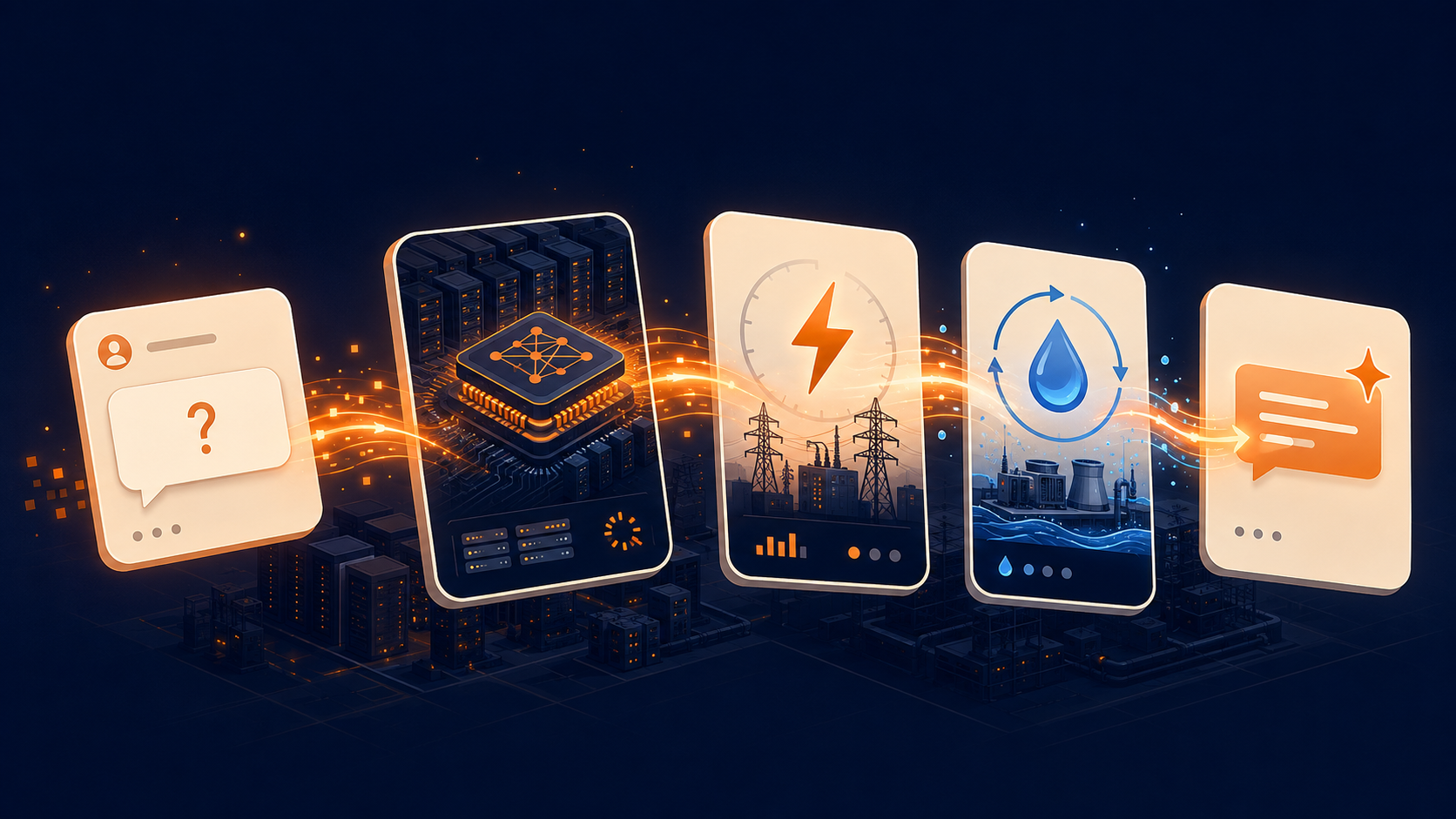
When I type a question into a chat and see an answer a few seconds later, it is easy to feel that the answer appeared on the screen. Before it reached the screen, the question travelled through a network, into computers with AI accelerators, through an electricity system, and through infrastructure that had to remove the heat created by the computation.
The useful question is not only How fast can AI answer? It is also: What resources sit behind one answer, and how confidently can we measure them?
The short answer: there is no universal number
If we ask how much electricity or water one prompt uses, the most honest answer is it depends on the system and the boundary we are measuring. A short question and a long document are different workloads. A small model and a large model do not perform the same amount of computation. A direct answer and a reasoning-heavy task are not the same job.
A per-prompt number should therefore be read as a scoped case study, not as a universal receipt for every AI system.
What happens between a prompt and a response?
A simplified path looks like this:
User prompt
     ↓
Tokenization and context preparation
     ↓
Model inference on GPU / TPU / AI accelerator
     ↓
CPU, memory, network, and storage
     ↓
Power distribution and cooling
     ↓
Response returned to the user
A prompt does not always enter a model as the words we see. The system splits text into smaller units called Tokens, then combines the current message with earlier conversation, retrieved documents, and system instructions into Context.
During Inference, the model repeatedly calculates what the next Token should be. Input length, Context length, and Output Tokens all affect the amount of work. A message that looks short to us may still carry a large context behind it.
The GPU is not working alone
GPU or TPU is a useful shorthand for AI computation, but it is not the whole system. The accelerator performs the main numerical work. CPU coordinates surrounding tasks. Memory holds active data. Network moves context and results. Storage keeps models and supporting data available.
A Data Center also keeps capacity ready for traffic spikes, failover, and reliability. Machines that are provisioned but not fully busy still have an energy cost. Measuring only the chip doing active computation can therefore miss part of the cost of serving a real system.
Why does electricity become heat?
Digital equipment does not turn electricity into an answer without a physical side effect. Most of the electricity used by the equipment eventually becomes heat. That heat has to leave the chip and the server room so the system can keep operating.
Cooling may use air, water, liquid systems, or a combination. Some Data Centers use chilled water or cooling towers. Others bring liquid closer to the heat source. A design that reduces water may require more electricity, while a design that reduces electricity may have a different water trade-off. The engineering answer depends on the site.
PUE (Power Usage Effectiveness) compares total Data Center electricity with the electricity used directly by IT equipment. WUE (Water Usage Effectiveness) is commonly used to describe site water use. Lower PUE or WUE is useful evidence within a defined boundary; neither metric makes two different facilities automatically comparable.
Water can enter the picture in at least two ways
Direct water use is water used at the facility, such as for cooling and heat rejection. It depends on cooling technology, weather, building design, and local constraints.
Indirect water use is associated with generating the electricity that the Data Center consumes. Different power plants have different water footprints. The same server workload can therefore have a different water impact when it runs in a different grid or region.
The question How many drops of water does an AI prompt use? needs a second question: are we counting only facility cooling, or also water associated with electricity generation? Are we measuring withdrawal, or water consumed and not returned to the immediate cycle? Without a boundary, two numbers can look contradictory while measuring different things.
What does the 0.24 Wh figure mean?
In August 2025, Google Cloud published a methodology for measuring the impact of inference in Gemini Apps. It estimated that the median Gemini Apps text prompt used 0.24 Wh of energy and 0.26 mL of water, or about five drops. The analysis used data from May 2025 and describes Gemini Apps; it is not an average for every provider or every model.
The useful detail is the scope. Google says its comprehensive approach includes provisioned capacity that is idle, CPU and RAM, Data Center overhead, and cooling-related energy through PUE. A method that counts only active TPU and GPU consumption produces a much lower estimate.
Google also states the limits: this is a point-in-time analysis of a median prompt, it does not represent every Gemini prompt or future performance, and the data and claims have not been independently verified by a third party. The number is useful because its method and boundary are visible, not because it is a universal answer.
From one prompt to the whole electricity system
Per-task efficiency and total demand are different questions. Energy per task can fall while the number of users, prompts, and AI-enabled workflows rises.
The IEA’s updated Key Questions on Energy and AI outlook estimates that global Data Center electricity consumption could rise from about 485 TWh in 2025 to 950 TWh in 2030, roughly doubling. Electricity consumption from AI-focused Data Centers is projected to triple over the same period. The IEA says Data Centers could account for around 3% of global electricity demand in 2030.
That global number does not tell us that every prompt uses the same amount of electricity. Google’s 0.24 Wh estimate cannot be used as a substitute for 950 TWh. Together, the two views show why we need to measure both efficiency per useful workload and total workload.
Why can water estimates vary so much?
A Berkeley Lab study published in 2025 reviewed the factors that determine workload-level Data Center water use. It found variations exceeding 10,000-fold. The differences were linked to server efficiency, water factors in the electrical grid, server utilization, cooling technology, infrastructure efficiency, climate zone, inactive server share, and server refresh cycles.
This does not mean one ordinary prompt automatically jumps from a drop to thousands of litres. It means that a number from one facility or method should not be transferred to another system without checking the scope. There is no single recipe for minimum water use across every site.
Training and inference are different workloads
Training adjusts model parameters using large datasets. A training run may repeat many passes and use many accelerators for a long time. Inference uses a trained model to produce an output, such as answering a prompt or classifying text.
When people ask about the resource use of one prompt, they usually mean inference. But an AI service also has costs from training, experiments, model storage, index building, evaluation, and the infrastructure that supports them. Any comparison should say whether it covers serving only or a wider lifecycle.
One agent task may contain many model calls
A simple chatbot answer may require one model call. An Agent that works through a task may call a model to plan, retrieve information, use a tool, check the result, correct a step, and write the final response. It may also call an embedding model, a database, or an external service.
User task
  ├─ Plan
  ├─ Retrieve context
  ├─ Call a tool
  ├─ Check the result
  ├─ Retry or correct
  └─ Final response
If we count energy per prompt but do not know how many model calls make up a task, we can underestimate the workload. For Agents, measure resource use per task together with call count, Tokens, latency, tools, retries, and successful outcome—not only the final text a user sees.
Better efficiency does not guarantee lower total demand
A system may answer faster, use less energy per Token, and run on more efficient hardware. At the same time, people may use it more often, send longer context, request multiple alternatives, or leave an Agent running across many steps.
That is not an argument against efficiency work. It is an argument for tracking two measures together: cost per useful result and total workload. Per-answer efficiency shows whether the design improved. Total demand shows how much work the system is actually doing.
Where can engineers reduce unnecessary work?
Start with the result the system actually needs, then choose a method that fits the job.
- Use Model Routing: classification, extraction, and reformatting may fit a smaller, faster model; multi-step planning may need a stronger one.
- Keep Context relevant. Use Retrieval and remove duplicate material instead of sending everything every time.
- Set an Output Length and stop generation when the useful result is complete.
- Cache repeated questions or Context, and use Batching when latency allows it.
- Inspect retries and Agent loops so a model is not called again without a reason or a Stop Condition.
- Measure Tokens, latency, utilization, error rate, and output quality by Workload. Do not let one average hide an unusually expensive path.
- At the Infrastructure level, choose hardware with better performance per Watt, schedule work carefully, and consider cooling and local water conditions together rather than moving a burden from electricity to water without seeing the trade-off.
Reducing Context does not mean making every answer as short as possible. If a short answer causes several follow-up prompts, the system may use more resources overall. The goal is a useful result per task, not the lowest value for one isolated metric.
How to read a number without mistaking precision for certainty
Before comparing energy or water figures, ask: Which model was measured? When? How were Input and Output Tokens counted? Were CPU, RAM, Network, idle capacity, and PUE included? Is the water figure direct only, or does it include the grid? Is it a median, an average, or a high case?
Without those answers, a figure may still start a useful conversation, but it should not become a benchmark that judges an entire provider or system.
Takeaway
- One AI response depends on accelerators, CPU, memory, network, electricity, and cooling in a Data Center.
- There is no universal Energy per Prompt because model, context, Tokens, hardware, utilization, PUE, and location differ.
- Water can be direct cooling use or indirect use associated with electricity generation; the boundary must be explicit.
- Training, inference, and Agentic Workloads have different resource patterns, and one user task may contain many Model Calls.
- Good engineering starts with necessary work: routing, caching, retrieval, batching, output control, and measurement of useful outcomes.
Sources and measurement notes
- Google Cloud: Measuring the environmental impact of AI inference
- IEA: Key Questions on Energy and AI
- Berkeley Lab: The water use of data center workloads
- Berkeley Lab: 2024 United States Data Center Energy Usage Report
The figures in this article are tied to the dates and boundaries reported by their sources. They are not a claim that every prompt has the same resource cost.